Showing posts with label fiction. Show all posts

Friday, April 13, 2012

Book Review - Allison Hewitt is Trapped, by Madeleine Roux

A woman fighting zombies with an axe in a bookstore? How could I not be curious after just looking at the cover? I saw this one getting decidedly mixed reviews, but honestly, I found it to have nearly everything I was looking for in a zombie apocalypse book. Granted, there are a few things that I think could have been done better, but generally speaking, I had a great time reading this.

The title aptly describes the framework and entry point of the book: Allison Hewitt, a literature major and bookstore employee, finds herself locked in her place of employment after the zombie apocalypse spills across her town. Against all odds, she manages to find a wireless Internet connection near the bookstore, through some kind of emergency network called SNet. Allison begins to record the daily horrors of her new existence, initially as a way of staying sane and embracing something that seems normal. Eventually, however, the detached snark of her entries evolves into something else, as she moves to increasingly tenuous sanctuaries and her circumstances grow more desperate. Meanwhile, a community of survivors grows out of the blog's comment threads. Her new, faceless audience provides solace, warning, and advice as she decides to risk everything and strike out on her own to find her mother.

The story progresses exactly as one would expect, and though it contains plenty of familiar tropes, it feels distinctly like homage rather than retread. The secondary characters are just fleshed out enough to avoid being cardboard cutouts, but honestly, Allison has such a strong voice that I was largely fine with focusing mainly on her. The current example of a contiguous ensemble piece in the zombie genre is The Walking Dead comic, and that has rapidly devolved into a histrionic melodrama; comparatively speaking, I find the focus on one character to be refreshing. Her constant sarcasm does threaten to get in the way of the dialogue and action from time to time, especially when Roux puts especially elaborate one-liners in her mouth. However, it’s a fair price to pay for the creepy sense of whistling in the dark that it provides. Naturally, there’s plenty of wading through zombie gore and battling past sinister human survivors, and the book never gets boring, despite the various claustrophobic settings in which Allison finds herself trapped.

I do think that the book’s gimmick falls a little flat, or at least falls short of what it could have been. Telling the story of the zombie plague through a blog is a really neat idea, even with the vague and unrealistic setup it gets here. The comments, especially, are an intriguing way to move the story along. While Roux does some interesting things with this in the beginning, it eventually tapers off in favor of long-winded posts that look suspiciously like book chapters, with a few repetitive “good to see you’re still alive” comments tacked on. It doesn’t feel like Roux fully commits to the idea of this story being a blog. Between the weird present-tense delivery and the gradual inclusion of very specific narrative detail, the posts just don’t seem like posts. Nobody writes a blog like that, even if they have nothing else to do. There are a few instances of awkward writing that I choose to attribute to Allison instead of the author, but I wanted more consistent dedication to the format.

That particular failure to suspend my disbelief didn’t take away from my enjoyment, though. Terror, humor, violence, and romance are deftly mixed, and I found it genuinely hard to put down. Though this book isn’t particularly elegant, it’s still going up on my zombie pantheon shelf alongside Max Brooks.

Verdict: 4 / 5

Tuesday, March 27, 2012

Book Review - The Last Storyteller, by Frank Delaney

I was offered a free copy of this book to review, being the unapologetic fan of Delaney’s that I am, and would like to offer my thanks for that opportunity. That being said, this book made me nervous. I normally tear through Delaney’s books, but this one was slow going for me. I was actually convinced about halfway through that I wouldn’t like it, and then dramatically changed course when I got to the superb last third of the book. As others have mentioned, this is the third book in a trilogy, and while I wouldn’t necessarily recommend this as a standalone novel, it is a wonderful conclusion to the story of Ben MacCarthy and Venetia Kelly.

I must admit that I still haven’t ready Venetia Kelly’s Travelling Show, despite being enthusiastic about Delaney’s other works. This shortcoming is what allowed me to view (and love) the previous book, The Matchmaker of Kenmare, as a standalone novel. Accordingly, I was a little more prepared for the continuity this time around; as with the previous books, this book is told from Ben MacCarthy’s point of view as a thorough, winding memoir. The story is written as a chronicle of his life, left for his twin children.

After finding Venetia married to another man in Florida, Ben MacCarthy returns home to Ireland and attempts to puzzle out what he should do with his life. He inherits the mantle of his venerable folklore-collecting mentor and begins to collect the tales of the famous storyteller John Jacob O’Neill. The stories he hears in O’Neill’s house seem eerily prophetic, as they parallel events in Ben’s life- since returning to Ireland, he has managed to fall in with an IRA gun-runner, which puts him squarely in the sights of both his dubious new friends’ colleagues and some unfriendly police detectives. When Venetia shows up in Ireland again, touring with her abusive new husband’s illusion show, Ben is compelled to act in order try and salvage the happily ever after that he has ached for since Venetia’s disappearance. This compulsion, combined with Ben’s tendency towards dark moodiness and reckless decisions, leads to an act that threatens to drown Ben in remorse and self-hatred. The only thing that can bring peace to Ben’s life is its one true constant: the stories he seeks out, dutifully records, and has all along been preparing himself to transform and tell to others.

The first few parts of this book proceed in a meandering, piecemeal fashion that is a hallmark of Delaney’s warm, organic style of prose. This time around, though, they seemed a lot more disconnected. As usual, we are treated to a cast of layered, interesting characters, which rise out of the mythic tapestry of Ireland’s countryside. The various situations that Ben finds himself tossed into (since, for all of his charm, Ben MacCarthy has always been a somewhat hapless protagonist) are a treat to read, but they never quite intersect in a meaningful way, as far as plot goes. At least, not at first. The story really picks up with the return of Venetia, and Ben’s daring plot to reunite with her. Once that gets going, though, the scenes before seem even less important.

It’s not until near the very end of the book that the big payoff comes, where Delaney connects Ben’s adventures with the rebels, his attempt to reclaim Venetia, and the journey to redemption he must take. True to form, the best part of the book is the suite of folk tales that intersperse the narrative, told with the lyrical bombast of an ancient seanchaí. Beyond their intrinsic loveliness, they serve as the glue that binds the story’s action to its theme, and lend a bit of more concrete mysticism as Ben’s story draws to a close. The epilogue, a matter-of-fact postscript written by Ben’s children, rounds out an ending that is enormously satisfying, regardless of whether the reader is familiar with the previous two books (and doubly satisfying if they are).

I suppose it takes a more observant reader than me to see these things coming together until the end of the book. I was flailing for a while, there. Things came together in a subtly beautiful way at the end, but to me, the first half felt a bit disjointed. Once Venetia enters the picture again, there are a lot of callbacks to the first book in the trilogy. Between my unfamiliarity with that book and the slow burn Delaney uses to tie everything together, I didn’t really feel invested in the story until I neared the end. For that reason, I’d be wary of recommending this as a standalone book. However, if you are a reader with a taste for wistfulness and clever writing, this book is definitely worth your time. The characters alone are worth the price of admission, and taken as a whole it tells a beautiful story. It goes without saying that this is a must-read for those that have read Venetia Kelly’s Traveling Show and The Matchmaker of Kenmare; I can’t think of a better way to end Ben’s story.

Verdict: 4 / 5

Saturday, February 11, 2012

Book Review - The Lake, by Banana Yoshimoto

It’s hard to summarize this novella-length story without giving too much away. In fact, I’d recommend against reading the marketing copy, since it spoils the one and only surprise in the book. It’s best described as a stilted and intensely awkward meet-cute, I guess. Introspective young woman notices odd neighbor, and almost despite herself, begins to reach out to him and draw him out of his shell. They begin a fragile romance as she gets closer to the truth of his ethereal weirdness, and both of them have to reconcile the baggage from their respective pasts if they have any chance of holding on to what begins to bloom between them.

That’s it, really. Lots of walking, lots of monologues, and lots of narrative exposition on the nature of people and relationships. This is very much a thinking person’s book (or, to put it less kindly, a navel-gazing session), and it fits within a defined subgenre of literary fiction that almost eschews plot in favor of evocative, poetic ruminations on the human condition, and how deep and interesting it is to be sad all the time. It definitely has the hallmark style of Japanese fiction, as well- the writing, while occasionally clumsy through the lens of a Western perspective, is consistently elegant, and often beautiful. There are some choice observations in the book that are eminently quotable.

I couldn’t get into it, though. I don’t know, maybe I’m forever ruined by a lifetime of comic books and genre fiction, but I don’t have much patience for this kind of aimless meandering in the stories I read. This isn’t a bad book by any definition of the word; it’s quite good, and short enough that none of its earnest heaviness is lost on the reader. But it’s also extremely slow, and has no character arcs to speak of. I was pleasantly diverted, but I can’t think of anything enthusiastic to say about it, other than that the prose itself was occasionally brilliant.

This is a good one if you’re in a self-reflective sort of mood, but it doesn’t do much in the way of escapism.

Verdict: 2 / 5

Thursday, January 26, 2012

Book Review - Miss Peregrine's Home for Peculiar Children, by Ransom Riggs

This book seems to polarize opinion in the way that most bestsellers do. I’d been hearing about this one in librarian circles for a bit before it exploded into the mass market consciousness, and decided it was worth a buy solely due to what I knew about the story. While the book carries a couple of substantial flaws, I enjoyed it about as much as I expected to, rational criticism be damned.

Jacob Portman spent his childhood in the thrall of his grandfather’s amazing stories, and the bizarre photographs that were displayed as proof of them. Even as Jacob grows into a sullen teenager, the unlikely recollections of a magical island where kids could float and lift boulders exerted a strange, nostalgic pull on him. On the night of his grandfather’s unexpected death, Jacob sees something impossible lurking in the night. Determined to find out once and for all if his grandfather was crazy (and whether he is heading down the same path, himself), Jacob ventures to the remote, supposedly magical Welsh island that sheltered his grandfather from the Nazis during World War II. Expecting to find closure, Jacob instead discovers that the weird tales and photos made more sense than he realized.

The first half of this book was absolutely perfect, as far as I was concerned. The writing is fantastic and the macabre mood is established and maintained with subtle skill. The full-page photos, genuine oddities around which Riggs wrote the book, are a nice gimmick and add a dark weirdness. Between all of this and the sinister-looking cover of the book, I think a lot of people got tripped up on the notion that this is a horror story. It certainly feels that way at the beginning, but before long, the plot takes a left turn and becomes a mishmash of superhero fantasy and standard YA action. The transition is pretty seamless, from a technical standpoint, but it takes some adjustment for readers who were expecting more horror or mystery.

Unfortunately, though I didn’t mind this new focus in the second half of the book, the writing didn’t work nearly as well past the halfway mark. The photographs that were so effective in the beginning, when the story and characters were being established, started to feel a little shoehorned in once the action got going. While some of the characters felt genuine, others seemed inconsistent or shallow. Emma in particular seemed a bit halfhearted in her characterization, which is kind of a big problem to have with your love interest. Worst of all, the ending of the book is decidedly weak, possessing a distinct episodic feel. “Want to know what happens next? Tune in next time!” For all of its charm, this book simply does not carry its weight as a standalone book, from a story perspective.

Still, the creepy wonder that suffuses the beginning of the book made a lasting impact on me. This is one of those rare books that captured me so thoroughly with its premise and atmosphere that I forgave more than I usually would in the actual plot. It is definitely not a perfect book, and its novelty doesn’t quite balance out its problems in execution. However, it is an extraordinarily fun book with an evocative setting, a slick presentation, and a genuinely interesting angle in the antique photos. The writing style is definitely skewed towards teen readers (and Riggs does a great job in capturing an authentic teen voice, at least in Jacob’s case), but this is a worthy read for anyone with a taste for gothic adventure. I look forward to the next book, even if I am annoyed that I don’t really have a choice in the matter.

Verdict: 4 / 5

Thursday, December 8, 2011

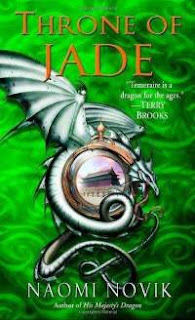
Book Review - Throne of Jade, by Naomi Novik

I was all riled up after finishing the first book in this series. Napoleonic wars, plus dragons? What’s not to love? In theory, this second volume of the Temeraire series should have piled on the awesome, adding nineteenth-century China to the mix. Granted, the book was… mildly awesome. I guess. In any event, it had all of the required elements to continue the story of the first book. However, the story and pacing is so weirdly listless that it was difficult to get excited at all about it.

The second book follows up on Temeraire’s origin as a mere egg: a gift from the emperor of China to Napoleon, seized en route by the Royal Navy. In the intervening time, the emperor has discovered the whereabouts of his truant gift, and furthermore, what use it has been put to. As revealed in the last book, Temeraire is a rare breed of dragon called a Celestial, bred as companions to royalty and expected to live as scholars rather than soldiers. Laurence, his loyalties already painfully divided, is summoned to the emperor’s court to answer for these twin affronts. As he and Temeraire begin the long journey to China, Laurence increasingly finds himself herded towards choosing between losing his beloved dragon and giving the hated French a powerful new ally.

The key phrase above is “long journey to China.” Most of the book is a drawn out ship voyage, which lends a certain staidness to the proceedings. Even with the occasional punctuation of action- some related to the larger plot, and some not- the middle of the book plods along, not really going beyond just marking time. It’s well-written, to be sure; the characters are still lovable, the dialogue has just the right amount of authentic stuffiness, and the blending of genres is as charming as it was in the first book. However, I found it difficult to stay engaged throughout the majority of the voyage.

When Laurence and Temeraire finally get to China, the damage kind of felt like it was done. Novik does some interesting things at this point, contrasting the way dragons are treated in Chinese society to the social norms that Laurence and Temeraire have heretofore taken for granted. The political intrigue is ratcheted up a bit, too, as the choice Laurence thought he was facing is revealed to be considerably more complicated. Again, though, nothing seems to rise above a dull roar. By the time the villains are revealed and the climactic confrontation begins, I was dismayed to realize that I didn’t really care enough to be affected too much by it. Especially considering that it plays out exactly as foreshadowed.

I don’t know. I liked this book, but I wanted to like it more, since I was so excited by the first one. This book technically works as a standalone, but I wouldn’t suggest starting with it. It’s weak compared to the first book, but it does reveal some interesting backstory on what Temeraire is and where he comes from.

Verdict: 2.5/5

Tuesday, December 6, 2011

Book Review - Why We Broke Up, by Daniel Handler and Maira Kalman

I picked an ARC of this book up from an unmanned pile sitting outside a film screening, and it ended up being a pleasant surprise. It took me a few chapters to get comfortable in the story. Something about the characters and the writing gnawed at me for a while, but I couldn’t put this book down after getting acquainted with the charcters, and ended up loving it despite a somewhat disappointing ending.

The author of this book is better known to many as Lemony Snicket, the creator of the Series of Unfortunate Events books. This book is a little less ostentatious, but does use a storytelling trope that is currently popular in teen lit: revolving the narrative around the description or progression of a physical object. In this case, it’s a box of bottle caps, flyers, and other mementos. The story is presented as a letter by Min Green, written to her ex-boyfriend Ed Slaterton and dumped on his porch with a box of detritus from their short and tempestuous relationship. The letter details each object in the box, placing them within a timeline that chronicles the unlikely meeting and courtship between odd, “arty” Min and the co-captain of the school basketball team. Each object is rendered in detail by artist Maira Kalman, though the ARC is sadly incomplete in this regard. Min narrates each description as a stepping stone through her first serious relationship to its inevitable (in her estimation) demise.

My first moments as a reader with Min were irritating, but as a testament to Handler’s talent, it was because she is a fully realized character right from the beginning. Min is replete with a smug, quirky bravado that only an intelligent but insecure teenager can appreciate. As the narrator of the letter/book, her exaggerated mannerisms and dramatic flourishes dominate each page. By the tenth run-on sentence and third unnecessary use of the word “whatnot” in the first two chapters, I was rolling my eyes.

Once I got accustomed to Min, though, the payoff for powering through was quite nice. She even acknowledged how pretentious and silly it was to throw “whatnot” around with such reckless abandon, eventually. The character that emerges as the story of her breakup unfolds is complex, sympathetic, and realistic: a teen girl who embraces eccentricity in order to bridge the awkward gap between childhood and adulthood, falling in love for the first time with someone she had no reason to even talk to. Despite her cleverness, she lets passion distract her from the signs of impending doom (like any teenager in love for the first time would), and is completely blind to the prospect of something beautiful that’s been in front of her the whole time.

Handler and Kalman’s grab bag of tricks keeps things interesting. Even without the benefit of the complete art, the introduction of each “chapter” with a rendering of an object from Min’s box keeps the whole affair from seeming too much like a checklist. While some of the supporting characters feel a little shallow and underexplored, the dialogue is snappy and the streak of jaded irony that all of them seem to share creates a consistent, humorous set piece. I was particularly amused by the constant references to obscure cinema; Min tends to compare everything in her life to her favorite scenes from a variety of arthouse foreign films, all of which she discovers through a well-loved reference book on the subject. I read over half of the book before it dawned on me that all of those references to classic films, actors, directors, and musicians were completely made up. The thing is, since Min is as much a hipster as any knit-capped twenty-something you’d find in real life, I had just assumed that they were real people and things that I just hadn’t heard of. Whether this was something Handler intentionally chose or just did for the sake of storywriting convenience, it felt like a gentle dig at being indie for indie’s sake, which fit perfectly into the dry humor and sweet vulnerability that suffused the rest of the book.

The only hiccup for me was with Min’s erstwhile love, Ed Slaterton. There isn’t a whole lot to his characterization, other than some brief hints at a tragic home life and the obvious revelation that teenage boys, even the good-hearted ones, are generally fuckups when it comes to relationships. Ed’s bemused normalcy does paint a nice contrast to Min’s over-the-top quirkiness. Also, it’s actually refreshing to have all of the theatrics of Min’s letter and box of memories lead to something as simple and time-tested as two kids who are crazy about each other, but lack the experience to keep from burning too quickly and trusting too blindly. Still, the story builds to a somewhat abrupt and underwhelming conclusion, realistic though it might be.

The book was a slow starter for me, but I was hooked once I got a few chapters in. It will be a mainstay recommendation for YA romance, and it’s a great read for anyone who doesn’t mind an emo sensibility and has a thing for Juno-esque “I’m precocious as hell but still an awkward girl that gets in over my head” protagonists.

Verdict: 4 / 5

Saturday, October 1, 2011

Book Review - Underdogs, by Markus Zusak

I don’t know what it is with me and omnibuses… omnibusseses… omnibi? Anything that’s packaged as a complete set, be it made up of novels or comics, tends to attract my attention these days. This particular omnibus appeared to me out of nowhere, and didn’t do anything for me at first. Somewhere between when I started it and when I finished it, though, it crept up on me and became one of my favorite recent reads. It’s a meandering, quirky coming-of-age story that is funny and heartbreaking by turns, and will definitely touch a chord in anybody who has been a teenage boy before.

This is a collection of Markus Zusak’s first published works, before his recent fame for writing The Book Thief. The trilogy, comprised of The Underdog, Fighting Ruben Wolfe, and Getting the Girl, is narrated by a teenager named Cameron Wolfe. Cameron is the youngest son in a blue-collar family trying to make ends meet in an Australian suburb, and the books are a mesh of his stream of consciousness and his poetic writings as he attempts to navigate through his daily existence. The first book, The Underdog, introduces the Wolfe family and follows Cam through an aimless period in his young life where he tries to reconcile who he wants to be with the reality of who he is. Fighting Ruben Wolfe offers a bit more of a linear story: feeling like they should somehow contribute to the family, which is facing increasingly dire straits, Cam and his older brother Ruben get mixed up in clandestine, amateur boxing. As they fight, though, Cam realizes that Ruben is fighting for something other than money, and that he might be fighting for something deeper, himself. The third book, Getting the Girl, brings the themes of the first two into a familiar focus: first love and its consequences, which refines and changes everything that Cameron thought he had knew about himself.

At first, I wasn’t so impressed. I have a consciousness that streams just fine on its own, and so I tend to get annoyed by fiction that doesn’t have a point. But the Wolfe family makes an indelible impression, and Cam in particular is intensely likeable in all his quiet nobility and earnest insecurity. Once I got accustomed to the tone of this particular slice of life (which, with all of its Australian mannerisms and references, took me a bit to do), the narrative began to solidify a little, first into an exploration of the fraught relationship between close siblings, and then into a time-tested story of love and frustration. The character development is particularly excellent, and gets more nuanced throughout the books. Fighting Ruben Wolfe’s themes of sibling rivalry and family bonds build directly on Cam’s observations from The Underdogs, while the messy relationships in Getting the Girl spring from the character development in Fighting Ruben Wolfe. Taken as a whole, the story arc is subtle, and brilliant.

Getting the Girl particularly resonated with me. It could have easily been another entry in a somewhat crowded genre: horny teen boy learns a lesson about healthy relationships! As funny and enjoyable as books in that vein can be, they don't usually do too much for me. Perhaps it’s because most of those stories only touch the surface of what it’s like to have an adult’s sex drive but a child’s impulse control, and I don’t harbor any particular nostalgia for the situations that arise from that. But Zusak’s take on this particular form of teen angst struck home. While reading this, I occasionally mused that girlfriends and mothers should give these books a spin to gain some insight into the teen boy’s brain. Cameron struggles with the conflict between his hormones (sex with any female that looks his way, and proving once and for all that he isn’t a loser) and his heart (the little-boy desire of wanting to be nurtured and loved, and the manliness of being perceived as honorable and chivalrous). The results are the same insecurity, shame, and tendency towards self-defeat that almost every boy has to go through while growing up, and find inventive ways to cope with. His sexual fantasies are constant, and he accepts their inevitability. He also can’t help but fall in love at the drop of a hat, desperate to find something noble that gives those fantasies meaning, which makes him even more self-conscious. And best of all, this is not a motif that show up fully formed in the third book, even though the story itself stands alone. Rather, it is the result of Cameron’s character growth up to that point. It is beautifully understated, and cathartic to read, at least for me.

The only complaint I have with this book is the same complaint I have with every omnibus edition I read, and it has to do with the cognitive dissonance of reconciling the chapters of a collection to actual standalone books. As I mentioned, my infatuation with this book was a slow burn, since I was a little nonplussed by The Underdog and didn’t warm up to it until well past the halfway mark. If I were reading the standalone novel instead of this compilation, I don’t think I would have hung around for the following books, and that would have been a terrible loss. But as always, I can’t decide whether that speaks to a failure in the writing, or with me being psyched out by reaching the end of the “book” even though I have hundreds of pages left to read in the volume I’m holding. Suffice it to say that the first book is considerably more freeform and light on actual plot than the other two, so it pays off to stick it out if that bothers you.

But besides that small issue, this is a fantastic little smorgasbord of coming-of-age vignettes. It effortlessly brought me back to my own struggles with my self-worth as a young man, and it has the mark of a truly great read: the more I ruminate on it after finishing it, the more I love it. I would particularly recommend this to teen guys, who I suspect would not object to a little stealth introspection hidden amongst a tale of girls, fighting, and making fun of stupid little yappy dogs.

Verdict: 4.5 / 5

Wednesday, September 14, 2011

Book Review - A Dance with Dragons, by George R. R. Martin

George R. R. Martin would like you to know that he bought a dictionary of archaic Scottish English in the six years it took to write this book, and he learned a lot of cool words from it.

For example, did you know “leal” was used instead of loyal? It’s true! Also, you can use “neeps” to refer to rutabaga or turnips. And we already know that the word “teats” is awesome, of course, but let’s not forget the marvelous utility of the word “cunt!” It can refer to a woman’s body part, the woman herself, or just be a general exclamation of frustration in any situation where a woman might be involved to the slightest degree!

So, if you’re as excited about these words as you were to read about “groats,” “nuncles,” and “valonqars” in 2005, make sure to pick up A Dance with Dragons. George is so excited about this new batch of words that you are sure to get your money’s worth! Cunt leal cunny cunt leal teats neeps neeps cuntcuntcunt.

Okay, for real, now. I kept my hopes at a reasonably low level after the massive letdown that was A Feast for Crows, and it’s a good thing I did, because there is no appreciable difference between that book and this one. On one hand, that’s kind of a good thing; these two books started as one book, and inhabit the same chronological space in the overarching story while encompassing two different groups of main characters. A radical shift in the writing would have been jarring. However, setting aside the problem of this format slowing the overarching story down to a crawl, the consistency also means that the same infuriatingly bad writing in A Feast for Crows is slathered all over this one, as well, which distracted me from the truly gripping story underneath.

The War of Five Kings is all but over, but the stage is being set for the return of House Targaryen, which could change everything. Daenerys Targaryen struggles to maintain her hold on the slaver city of Meereen, while enemies descend on her from all sides and her famed dragons grow increasingly hard to control. A number of potential suitors race across the narrow sea to her, hoping to win her hand and tip the balance in Westeros: Victarion Greyjoy of the Iron Islands, Quentyn Martell of Dorne, and a young sellsword boy who hides a powerful secret. Even Ser Jorah Mormont hopes to once again reach the exiled queen, with none other than Tyrion Lannister in tow. Meanwhile, Jon Snow keeps his eyes fixed beyond the wall, balancing a tenuous grasp on the Night’s Watch command with the need to do anything it takes to defend against the horrors that are coming with the winter. And, let’s see… Bran’s up in the north learning how to be the best skinchanger ever, while Arya’s still in Braavos learning how to be awesome.

In other words, lots of Going Important Places and Saying Important Things, and not much else. There’s plenty of action interspersed in the various chapters and settings, but most of it is subdued; we’re back to intrigue and foreshadowing as we build up to what promises to be a huge denouement in the final books. The problem is, Martin has established himself to be a master at world-building and writing on a large scale, but as the last book proved, he’s god-awful at writing dialogue and creating small, intimate scenes. Unfortunately, dialogue and intimate scenes make up the lion’s share of this book. So, even though most of these chapters are still pretty interesting, they don’t move the story forward too much, and showcase some of the worst aspects of Martin’s writing.

As I mentioned above, Martin continues his maddening habit of suddenly introducing archaic words that don’t mesh at all with the rest of the prose, and repeating them until you want to use the book to bash your own face in. He also continues to invent new clichés that didn’t exist in the books before, and throw them around like confetti. In this book, people aren’t speculating on anything’s worth in groats anymore, but they all agree that “words are wind.” It’s not just the Westerosi who mutter this gem at any given opportunity; people across the sea, who supposedly speak entirely different languages, are also prone to blurting it out whenever anybody promises anything to anybody else. Also, it’s apparently in fashion to point out that nipples on a breastplate are useless. That one shows up at least twice, and then… spoiler alert!… somebody finds an actual breastplate… with nipples on it! Ha ha! Ha. Meanwhile, expect Tyrion to basically repeat two things for the entire book. Considering how great a character he has been to this point, this is particularly depressing.

The sex scenes, frequent as ever, continue to range between somewhat odd and painfully bad. Well, at least this time Martin isn’t obsessively fixating on the differing sizes and colors of women’s nipp… oh, wait, there it is. And… yup. There’s another passage, a few chapters later. Sigh.

I know I’m nitpicking, but there are bigger issues at play, too. Entire story threads in this book are completely unnecessary. One particular character winds their way through the book, doing nothing much of note, and then suddenly dies at the end after accomplishing one thing of pertinence to the story. This is something that could have been handled in a single chapter. It could have been an aside in someone else’s chapter, for crying out loud. While stuff like this is good flavor text, it takes up a lot of space without adding much.

I’m being harsh, but I really do like this series, and since Martin is king of the fantasy world right now, there’s no point in lobbing softballs. I think Martin has started to believe his own hype. These books have become famous for their grittiness, and for no character being safe and no happy ending being guaranteed. It seems like Martin just assumes, by this point, that he can please the fans that have those expectations by just writing in as much casual violence and pointless sex as he can, and ending every chapter on a cliffhanger. Moreover, the series is starting to suffer from the same affliction that can be observed in every successful popular fiction series: once an author starts raking in wheelbarrows of money, nobody wants to suggest that their manuscripts need editing anymore. According to Clarion West, this man teaches other writers how to write fantasy and science fiction. It’s therefore somewhat alarming to observe that he not only didn’t recognize that his two most recent thousand-page novels should have been three-fifths of a single manuscript (at best!), but that he feels the best way to establish a leitmotif is with unrelenting, context-free repetition. The fact that things go wonky when he strays from that repetition (“womb” is not a synonym for vagina, George) doesn’t do much to reassure me. And nobody seemed to have the courage to point these things out to him. Or, more likely, nobody cared, since this book was bound to be a bestseller anyway, regardless of whether it is actually good.

So, with me ranting full bore about this book, is it safe to assume I hated it? Sigh. No. I devoured it, just like the rest of the series. Once again, it must be said that underneath all of the stupid crap is a solid, engrossing, intricate story. It’s tightly plotted, despite the sudden meandering pace, and the themes are smart, realistic, and consistent, even if they are poorly presented. This series is visceral. Each page is alive with textures, smells, sounds, and a sense of unflinching reality. There are important messages in this story, about the nature of power, the arbitrary whims of fate, and the ambiguity of concepts like morality and justice. And though I’m sick to death of Martin’s cliffhangers, there are a couple of jaw-dropping moments in A Dance with Dragons that promise big things in the next books.

It bears repeating that this book is basically the second half of A Feast for Crows, six years or no six years, and thus deserves the same rating I gave that one. I’m not done with this series. I’m still a fan, and I need to know what happens next. I still think anybody who reads fantasy should read the first three books in this series, at least. But this book and the one before are badly written. It’s as simple as that. Not bad enough to ruin the series, but bad enough to pale in comparison to the previous books. I’d be lying, though, if I said I didn’t like it enough to tear through it and wait in anticipation for the next one.

The nice thing about all of this, as my wife and I often joke about, is that I get to be a fantasy hipster, now. While the newcomers rave about Game of Thrones and buy the reprinted paperbacks with the HBO logo on the cover, I get to smooth my moustache, crack open a Pabst Blue Ribbon, and declare that I was into Game of Thrones before it was big, and was already disappointed with it before you ever heard of it.

Verdict: 2.5 / 5, plus extra credit for being gripping despite its massive shortcomings.

Tuesday, September 13, 2011

Book Review - Nowhere Girl, by A. J. Paquette

As I was walking through the exhibit floor at ALA Annual, I chanced to pick up an advance reader’s copy for a children’s book that had some very nice art on the cover, a definite rarity for ARCs. I browsed through the blurbs, and discovered that this particular children’s book is about a girl who grew up in a Thai women’s prison.

I dare you to say no to a children’s book set in a Thai women’s prison. If you say you aren’t interested in how that turns out, you’re a filthy liar.

Naturally, being a children’s book, this story isn’t as eyebrow-raising as one might fear/hope. It’s actually a sweet little parable, set against a very memorable backdrop. Luchi Ann was born behind the bars of the prison, tucked away in the Thai hinterlands and far removed from any semblance of civilization. It is the only home she has ever known, and has always brought here a naïve, sheltered form of comfort. After her mother unexpectedly dies, however, Luchi is propelled into the outside world, more lonely and vulnerable than she has ever been. With only the name and address of an American who might be her grandmother, Luchi must somehow find her way back to a home she’s never known. However, the secrets that sent her mother to prison in the first place may come back to claim her.

While the initial setup and opening chapters of this book are compelling, it doesn’t really have a solid finish. The story starts to come apart about halfway through, and ends with a climax and some drawing-room revelations that are somewhat absurd. The plot works, but the various resolutions to Luchi’s obstacles are too convenient, and overly saccharine. The unique premise and shallow execution make for a story that’s a little hard to take seriously, despite its earnestness. In fact, its earnestness occasionally gets in the way, too, with pages of overwrought internal dialogue and paragraphs of exposition that routinely go purple.

But of course, that’s coming from an adult reader. None of this should present a problem for the school-age readers for which the book is meant. Further, Paquette has a gift for setting; her depictions of Thailand are lyrical and vivid, and even the somewhat unbelievable section describing Luchi's boat trip had me interested enough to look up more information on freighter travel. The story itself has an interesting and likeable protagonist, a carefully constructed theme, and a taste of suspenseful danger without being too intense for the target age range.

Overall: a mediocre but solid book. I wasn’t very excited about it personally, but I wouldn’t hesitate to recommend this to a young reader who is looking for a travel story, drama, or a book about Asian cultures.

Verdict: 3 / 5

Thursday, August 25, 2011

Book Review - The Future of Us, by Jay Asher and Carolyn Mackler

This kind of book is not my usual choice, but I had the good fortune to meet the authors and get an autographed advance reader’s copy. Turns out, this is right up my alley, and I just didn’t know it yet. While not particularly profound, it is a quick, smart, and satisfying read.

This book’s concept is largely unchanged from the random conversation between the authors that I’m sure it came from. It’s 1996, and Emma’s best friend Josh comes over with one of those America Online CD-ROMs we all once got in the mail and promptly put in the microwave for their pyrotechnic value. Or, you know, used them as coasters, or whatever the rest of you did with them. Anyway, as Emma prepares to venture into the Interwebs, she notices a blue-and-white login box. Thinking this part of AOL, she enters her password again, which leads her to some strange website called Facebook. Further exploration with Josh reveals what seem to be versions of themselves from fifteen years in the future, with everything one would expect from a Facebook page: photos, banal status updates and... naturally... relationship status. Suddenly endowed with the ability to know her future and take steps to change it, Emma begins fiddling with her own future based on the scraps of info she can pull from her future self’s Facebook wall. Josh, on the other hand, fears what such meddling could do to their lives, both in the future and in the here-and-now.

This book grabbed me for a very specific reason. I am 31 years old, and therefore was the exact same age as these characters at the exact time it takes place. It’s like a cultural love letter to my youth. Furthermore, I spent the nineties dealing with the unrequited love of a close friend or two (as I imagine many of you have, as well), so I found the dynamic between Emma and Josh painfully realistic. My personal biases aside, though, this is a pretty neat story. Time-travel stories are fraught with peril, in that they invite science nerds to point out everything logistically wrong with them, but this one is believable. It keeps the “how” vague, because honestly, “how” doesn’t matter. The characters matter, and this story stays focused on them, with split-perspective narration between Emma and Josh that works well and keeps the book moving. There is a strong theme of not being so caught up in tomorrow that you neglect today, but it’s a theme that is inherent and not delivered heavy-handedly. This is a book that’s easy to get caught up in; I devoured it relatively quickly.

The only problem I had with the book has to do with the same reason it resonated so easily with me. I’m not entirely sure what the audience is for this book. Because it’s marketed as YA, it has to do some heavy lifting in terms of setting. Today’s teens don’t remember the 90s, and so there are constant shoutouts to the fads and pop culture of the time. Some of this works (the music, in particular), but most of it feels awkward and gratuitous, and makes the time-travel aspect seem a little gimmicky. On the other hand, while The Future of Us is tailor-made for those of us who actually grew up in the 90s, it doesn’t quite go deep enough to tap into that thirty-something sensibility. There are a couple of great scenes in the book that show how mutable the future is, but instead of really throwing a curveball like it could have, the story ends on a tidy, sweet, and predictable note. Honestly, I think Asher and Mackler could have done a lot more with this story (with everything about it intact) if they had aimed it at adults instead of the YA market.

But for what it is, it’s fantastic. This is a quirky little romance that’s perfect for socially networked teens, and it’s a cultural paean to those of us who actually got those CD-ROMs in the mail, once upon a time.

Verdict: 4 / 5

Saturday, August 13, 2011

Book Review - Glow, by Amy Kathleen Ryan

This is definitely a case of the right book hitting me at the right time. I’m currently neck-deep in an addiction to the video game Mass Effect 2, which has precipitated a definite sci-fi jag in my entertainment tastes. This rich little dollop of YA sci-fi, which I got to read as an advance reader's copy and will be published in September, is just what I was looking for. It had a couple of procedural issues, which kind of makes me want to knock a point off depending on my mood, but this is a great start to what promises to be a fun series.

The first volume of the Sky Chasers series introduces Kieran Alden and Waverly Marshall, a young couple aboard a huge starship called the Empyrean. The Empyrean and its sister ship, the New Horizon, left an ailing Earth over forty years ago, carrying the hope of creating a new world and saving the human species from extinction. Kieran, being the first baby born to the original Empyrean crew and an all-around golden boy, is first in line for the ship’s captaincy. Everyone expects that he and Waverly will get married, and she does love him, but she has her doubts about whether she really wants to marry him, or if she is merely succumbing under the moral imperative to procreate. Her realtively sedate troubles are violently interrupted by the appearance of the New Horizon, which is supposed to be years ahead of them. An unexpected turn of events separates Waverly and the other Empyrean girls from everyone they’ve ever known, where they must find a way to escape a desperate captivity that is insidiously disguised by good intentions and comforting lies. Meanwhile, Kieran finds his capacity for leadership truly tested, when Seth Ardvale, a rival for Waverly’s affections, decides that Kieran isn’t fit to lead. Facing an increasingly dangerous mutiny and with no adults available to step in and take charge, Kieran is forged into a leader that might save them all, or might take them further down the path to annihilation.

So, I need to address two things right away. First, more and more teen books have characters with names like Kieran, Waverly, Brayden, Madison, et cetera, and my irritation with this is proof that I’m officially getting old. Second, I really wish everybody would stop trying to market new books as “The Next” version of whatever recently made piles of money. Yes, this actually is a fantastic readalike for The Hunger Games, but it doesn’t change the fact that repeatedly bleating “OMG THE NEXT HUNGER GAMES” is marketing at its most crass, and it makes my eyes twitch.

Okay, with that out of the way: this is solid sci-fi, and a fantastic teen book. It definitely places more emphasis on action and character development than it does on space and starships, but it does what it does very well. Of particular note is the interesting way in which it handles religion. A few chapters in, I was ready to dismiss this one as another version of the same story I’ve read plenty of times: religion bad. Being no fan of religious fundamentalism myself, I’m pretty okay with that, but it’s a somewhat tired trope. But then Ryan pulled the rug out from under me: secularism bad, religion good? Wait, no, religion still bad, maybe? Turns out, religion and secularism in this book’s universe are as good or as bad as their adherents. Gee, what a concept. And this not only makes for intriguing character motivations, but deftly sets up the framework and dominant theme for the rest of the books in the series. This, more than anything else, has me excited about how the next books will turn out.

The only problem I had with this book is that it had a whole lot of story tell in a fairly short amount of time. Like I said above, Glow is action-packed, and things move along briskly and with satisfying tension. Trouble is, the story occurs over several months, and it’s somewhat disorienting trying to reconcile the dialed-up pace with the apparently missing chunks of story time. The problem is exacerbated by the split in the narrative; once Waverly and Kieran are separated, the book follows their individual stories in different chapters. Each story could conceivably have its own novel-length treatment, but they are combined into a slim multithreaded plot in which they chronologically overlap. The process leaves certain elements feeling unexplored, or even artificially rushed.

The book also ends with a massive cliffhanger, making no bones about being the first part of a series. However, the two story halves each get a respectable climax, and the cliffhanger comes at the end of some dramatic falling action, letting Glow stand alone quite well. I think there are a few too many things to pick at to call Glow a complete success, but I personally loved it. The story is exciting and satisfying, the setting is a fresh take on a familiar concept, and the utopian themes and realistic motivations are a breath of fresh air in an expanding field of teen sci-fi where the bad guys are bad because they’re just bad, man, and it’s up to the teenagers to make everything all right.

That, I think is my favorite thing about this book: it isn’t at all clear who “the good guys” are, or what the best course of action for the teen protagonists is.

Verdict: 5 / 5