Erebos is an entry in the “takes place in an online game” genre, which has been around for a while but is seeing a recent resurgence. It’s apparently getting enough hype from its original German publication to justify an English translation. I did a lot of vacillating while reading this; I came close to hating it in the beginning, got hooked somewhere in the middle, and finished it feeling content but vaguely dissatisfied. It does a lot of things very well, but could probably do some other things better.
The story revolves around Nick Dunsmore, a student in a London school. Nick notices that his friends and acquaintances are beginning to act strangely and are increasingly missing from class, and eventually discovers that a secretive package is making the rounds among them. When Nick is finally inducted into this mysterious club, he finds that the package contains a burned CD of an online multiplayer game called Erebos. It is like no other game that Nick has ever played before; it comes with very strict rules about secrecy, and seems almost able to read his mind. Furthermore, the game begins to assign him incomprehensible tasks in the real word in order for his character to climb the ranks. It soon becomes clear that Erebos may be part of a grander, more sinister design. By the time Nick realizes this, it may be too late to save his fellow addicted gamers.
The first half of the book covers Nick’s introduction to the game and his increasing infatuation with it, and thus takes place mostly in-game. At first, the transitions between Nick going about his daily business and his character Sarius exploring the game world are a little jarring, as there is very little in the way of segueing between the two. The descriptions of Sarius’s adventures are initially a little overblown; it’s hard to imagine anyone but a gamer being interested in stamina meters, world exploration, and hotkeys. Eventually, though, I found myself as hooked on Erebos as Nick was. The progression operates as seamlessly as playing an actual game. Once I was accustomed to the lore and rules, I slipped easily into the game world and eagerly followed each encounter. This, along with the escalating grimness of the game’s hold and demands on its players, makes for a exciting and suspenseful read.
Once I made it through the climax to the end, though, a couple of problems came back to the surface to haunt me (minor spoilers ahead). Even with all of the work that Poznanski puts in to explain how sophisticated the Erebos A.I. is, it still strains the limits of credulity. There are simply too many plot holes in the way of explaining how the game could maintain such a level of surveillance on its players, or how it was so difficult to see through its supposed omniscience as a player spent more time with it. The plot resolves itself admirably well, but ends a little too neatly. I was particularly bothered by the lack of consequences, especially considering that Nick is sort of a hard character to like in the first place. He uses the game to ruin the relationship of the girl he likes, and in the end… he gets to date her. The old boyfriend seems no worse for wear, despite enduring a false rape accusation by another girl. Meanwhile, the girl who actually levied the accusation on the game’s behalf is all smiles and “man, that was intense, huh, LOL” at the end. Not only is this unrealistic, but it actually imparts an unhealthy and even dangerous message, in my opinion. Even the fates of the villains at the end are left ambiguous, in favor of a satisfying but irrelevant explanation of which person was behind which username in the game (including the antagonist, repulsive nerds that apparently just wanted to be Nick's friend the whole time, or something).
I think I was bothered by all of this because I sense a missed opportunity. There could have been a much deeper exploration of what obsession can do to impressionable people, I think. As a result, the mass downplaying of consequences was disappointing. Even so, the book is adept in pulling a reader in, just as the titular game apparently is. It is nicely paced, and the central mystery is compelling. I wasn’t totally blown away, as there are better books about massively multiplayer online games out there. But this one gets a solid recommendation for gamers, fantasy fans, and readers who like action-heavy mysteries.
Verdict: 3 /5
Showing posts with label fantasy. Show all posts
Thursday, March 22, 2012
Thursday, February 23, 2012
Book Review - The False Prince, by Jennifer A. Nielsen
This is exactly the kind of fantasy I used to love when I was a kid: no-frills action with a charming rogue protagonist. Nielsen has done something admirable with this book, eschewing the high fantasy tropes that would work so well with an audience accustomed to wizards and dragons, and instead focusing solely on royal intrigue. I enjoyed this book because it falls within the spectrum of gritty fantasy, which is my genre of choice. It’s unfortunately hampered by a few major problems, though, even if those problems are only an issue for readers outside the target audience.
The story itself is pretty straightforward, and neatly summarized in the book’s blurb: Sage, a wily orphan, gets noticed by a passing nobleman, Lord Conner, and is recruited against his will for a scheme to take the throne of Carthya by deception. Unfortunately for Sage, he’s not the only orphan Lord Conner notices. There are three potential princes, but only one throne. Sage and his two new companions have a short amount of time to convince Lord Conner that they are the best fit for the plan, and it is painfully clear what will become of the two boys he does not choose. Sage, however, has a plan of his own- one more dangerous than even Lord Conner’s, but one that will hopefully keep all three of the false princes alive.
The plot certainly delivers on its premise, with a sense of urgency that is expertly maintained throughout the book. I sped through this book, due to its ability to keep me turning pages to find out what happens next. However, some of the methods Nielsen uses to keep the action going are used rather clumsily, and sometimes fail entirely. The main characters are surprisingly inconsistent; they are written as layered and unpredictable, but are prone to saying and doing things that are wildly out of character in order to move the story along. A pivotal scene in which Sage gains the upper hand over one of the other boys revolves around an event that makes no sense at all, either in the mechanics of the scene or in the motivations of the characters. There’s a twist near the end that helps bring the story to a close, but it’s a twist that’s easy to see coming and has enough drawing-room justification to feel too tidy.
It also must be mentioned that the book is written in the first person with Sage narrating, but as we get to the climactic scene at the end, we suddenly switch to omniscient third-person narration for a chapter. I understand that Sage's dramatic entrance at this point is the book's big payoff, but instead of sticking with him the whole way or alternating perspectives throughout the story, we have only this one third-person chapter. Maybe I’m being snobby, but that’s egregiously bad writing. Especially considering that it comes on the heels of a chapter-long flashback.
So, there are some definite flaws in execution, and the story’s resolution is a bit too convenient to be memorable. In the interest of fairness, though, this book is meant for a middle-grade to younger teen audience, who won't care a bit for these problems. Experienced fantasy readers will find this book unremarkable, but the suspense is ratcheted up to a nice level, the world-building is decent, and the pace is quick and enjoyable. This would be a good choice for newcomers to the genre who would like some human drama and intrigue in their fantasy books, and I would recommend it without qualification to younger readers looking for fantasy adventure.
Verdict: 2.5 / 5
The story itself is pretty straightforward, and neatly summarized in the book’s blurb: Sage, a wily orphan, gets noticed by a passing nobleman, Lord Conner, and is recruited against his will for a scheme to take the throne of Carthya by deception. Unfortunately for Sage, he’s not the only orphan Lord Conner notices. There are three potential princes, but only one throne. Sage and his two new companions have a short amount of time to convince Lord Conner that they are the best fit for the plan, and it is painfully clear what will become of the two boys he does not choose. Sage, however, has a plan of his own- one more dangerous than even Lord Conner’s, but one that will hopefully keep all three of the false princes alive.
The plot certainly delivers on its premise, with a sense of urgency that is expertly maintained throughout the book. I sped through this book, due to its ability to keep me turning pages to find out what happens next. However, some of the methods Nielsen uses to keep the action going are used rather clumsily, and sometimes fail entirely. The main characters are surprisingly inconsistent; they are written as layered and unpredictable, but are prone to saying and doing things that are wildly out of character in order to move the story along. A pivotal scene in which Sage gains the upper hand over one of the other boys revolves around an event that makes no sense at all, either in the mechanics of the scene or in the motivations of the characters. There’s a twist near the end that helps bring the story to a close, but it’s a twist that’s easy to see coming and has enough drawing-room justification to feel too tidy.
It also must be mentioned that the book is written in the first person with Sage narrating, but as we get to the climactic scene at the end, we suddenly switch to omniscient third-person narration for a chapter. I understand that Sage's dramatic entrance at this point is the book's big payoff, but instead of sticking with him the whole way or alternating perspectives throughout the story, we have only this one third-person chapter. Maybe I’m being snobby, but that’s egregiously bad writing. Especially considering that it comes on the heels of a chapter-long flashback.
So, there are some definite flaws in execution, and the story’s resolution is a bit too convenient to be memorable. In the interest of fairness, though, this book is meant for a middle-grade to younger teen audience, who won't care a bit for these problems. Experienced fantasy readers will find this book unremarkable, but the suspense is ratcheted up to a nice level, the world-building is decent, and the pace is quick and enjoyable. This would be a good choice for newcomers to the genre who would like some human drama and intrigue in their fantasy books, and I would recommend it without qualification to younger readers looking for fantasy adventure.
Verdict: 2.5 / 5
Wednesday, February 15, 2012
Book Review - The Color of Magic, by Terry Pratchett
Back when I was a teenager and first dipping my toes into writing fantasy fiction, one of my regular characters was a bumbling wizard that constantly broke the fourth wall. I hadn’t known at the time that I was essentially doing a rough-hewn Terry Pratchett impression; in fact, at that point I’m pretty sure the only humorous fantasy I had read was a book somewhere in the middle of Piers Anthony’s Xanth series. I read Pratchett’s Soul Music not long after creating that character, and realized even then that I had found something that would amplify and resonate my still-developing sense of humor. At last, here was a book that had everything I wanted from humorous fiction: a fantasy setting, plenty of magic, random absurdity, armloads of meta-humor, and a smirking disregard for the fourth wall. Also, unlike Anthony’s books, it didn’t leave me with the lingering urge to take a shower.
The slapstick aesthetic of the Discworld books (at least, the ones I’ve read) make them a little hard to follow. I’ve always wanted to try them from the beginning to see if things feel a bit more concrete that way, but now that I’ve read the first book, I have to say that it didn’t really help. In fact, this book hopped around so much that I was past the halfway mark by the time I got oriented and comfortable with the material. The Color of Magic is ostensibly a tale of the hapless wizard Rincewind, a naïve tourist named Twoflower that finds excitement in the most dangerous places, and a mysterious, ambulatory, and sapient piece of luggage, which follows them whereever they go and causes no end of trouble. In actuality, the book is a collection of four bizarre vignettes that are tied together by a whirlwind tour of Discworld’s odd cosmology, which is loaded with delightfully silly words and concepts, and often seems made up on the spot. The book is essentially a starting point for Rincewind, and an introduction to the Discworld universe, without much in the way of an actual story. It’s best described as a few zany episodes, capped off by a cliffhanger ending.
As such, it must be said that this is a bit of a niche read. It’s not for everyone. Enjoyment of this book hinges upon having an appreciation for wordplay, British humor, and fantasy clichés. Also, one can’t be too attached to the traditional ideas of character and story structure, or at least be open to the idea of deconstructing and satirizing them. That being said, I had a great time with this book once I adjusted my expectations. It was lighthearted and genuinely funny (in a shake-your-head-and-grin way, rather than a laugh-out-loud way), without being patronizing or one-note. The random locales and situations are hilariously inventive, and there are patterns of consistency throughout that effectively create a sense of setting and highlight what are sure to be future plot threads. While I suspect the quality of the later Discworld is much better, comparitively speaking, this is still a great read for anyone who wants to get away from the self-importance of most fantasy fiction and indulge in a little silliness.
Verdict: 3 / 5
The slapstick aesthetic of the Discworld books (at least, the ones I’ve read) make them a little hard to follow. I’ve always wanted to try them from the beginning to see if things feel a bit more concrete that way, but now that I’ve read the first book, I have to say that it didn’t really help. In fact, this book hopped around so much that I was past the halfway mark by the time I got oriented and comfortable with the material. The Color of Magic is ostensibly a tale of the hapless wizard Rincewind, a naïve tourist named Twoflower that finds excitement in the most dangerous places, and a mysterious, ambulatory, and sapient piece of luggage, which follows them whereever they go and causes no end of trouble. In actuality, the book is a collection of four bizarre vignettes that are tied together by a whirlwind tour of Discworld’s odd cosmology, which is loaded with delightfully silly words and concepts, and often seems made up on the spot. The book is essentially a starting point for Rincewind, and an introduction to the Discworld universe, without much in the way of an actual story. It’s best described as a few zany episodes, capped off by a cliffhanger ending.
As such, it must be said that this is a bit of a niche read. It’s not for everyone. Enjoyment of this book hinges upon having an appreciation for wordplay, British humor, and fantasy clichés. Also, one can’t be too attached to the traditional ideas of character and story structure, or at least be open to the idea of deconstructing and satirizing them. That being said, I had a great time with this book once I adjusted my expectations. It was lighthearted and genuinely funny (in a shake-your-head-and-grin way, rather than a laugh-out-loud way), without being patronizing or one-note. The random locales and situations are hilariously inventive, and there are patterns of consistency throughout that effectively create a sense of setting and highlight what are sure to be future plot threads. While I suspect the quality of the later Discworld is much better, comparitively speaking, this is still a great read for anyone who wants to get away from the self-importance of most fantasy fiction and indulge in a little silliness.
Verdict: 3 / 5
Thursday, January 26, 2012
Book Review - Miss Peregrine's Home for Peculiar Children, by Ransom Riggs
This book seems to polarize opinion in the way that most bestsellers do. I’d been hearing about this one in librarian circles for a bit before it exploded into the mass market consciousness, and decided it was worth a buy solely due to what I knew about the story. While the book carries a couple of substantial flaws, I enjoyed it about as much as I expected to, rational criticism be damned.
Jacob Portman spent his childhood in the thrall of his grandfather’s amazing stories, and the bizarre photographs that were displayed as proof of them. Even as Jacob grows into a sullen teenager, the unlikely recollections of a magical island where kids could float and lift boulders exerted a strange, nostalgic pull on him. On the night of his grandfather’s unexpected death, Jacob sees something impossible lurking in the night. Determined to find out once and for all if his grandfather was crazy (and whether he is heading down the same path, himself), Jacob ventures to the remote, supposedly magical Welsh island that sheltered his grandfather from the Nazis during World War II. Expecting to find closure, Jacob instead discovers that the weird tales and photos made more sense than he realized.
The first half of this book was absolutely perfect, as far as I was concerned. The writing is fantastic and the macabre mood is established and maintained with subtle skill. The full-page photos, genuine oddities around which Riggs wrote the book, are a nice gimmick and add a dark weirdness. Between all of this and the sinister-looking cover of the book, I think a lot of people got tripped up on the notion that this is a horror story. It certainly feels that way at the beginning, but before long, the plot takes a left turn and becomes a mishmash of superhero fantasy and standard YA action. The transition is pretty seamless, from a technical standpoint, but it takes some adjustment for readers who were expecting more horror or mystery.
Unfortunately, though I didn’t mind this new focus in the second half of the book, the writing didn’t work nearly as well past the halfway mark. The photographs that were so effective in the beginning, when the story and characters were being established, started to feel a little shoehorned in once the action got going. While some of the characters felt genuine, others seemed inconsistent or shallow. Emma in particular seemed a bit halfhearted in her characterization, which is kind of a big problem to have with your love interest. Worst of all, the ending of the book is decidedly weak, possessing a distinct episodic feel. “Want to know what happens next? Tune in next time!” For all of its charm, this book simply does not carry its weight as a standalone book, from a story perspective.
Still, the creepy wonder that suffuses the beginning of the book made a lasting impact on me. This is one of those rare books that captured me so thoroughly with its premise and atmosphere that I forgave more than I usually would in the actual plot. It is definitely not a perfect book, and its novelty doesn’t quite balance out its problems in execution. However, it is an extraordinarily fun book with an evocative setting, a slick presentation, and a genuinely interesting angle in the antique photos. The writing style is definitely skewed towards teen readers (and Riggs does a great job in capturing an authentic teen voice, at least in Jacob’s case), but this is a worthy read for anyone with a taste for gothic adventure. I look forward to the next book, even if I am annoyed that I don’t really have a choice in the matter.
Verdict: 4 / 5
Jacob Portman spent his childhood in the thrall of his grandfather’s amazing stories, and the bizarre photographs that were displayed as proof of them. Even as Jacob grows into a sullen teenager, the unlikely recollections of a magical island where kids could float and lift boulders exerted a strange, nostalgic pull on him. On the night of his grandfather’s unexpected death, Jacob sees something impossible lurking in the night. Determined to find out once and for all if his grandfather was crazy (and whether he is heading down the same path, himself), Jacob ventures to the remote, supposedly magical Welsh island that sheltered his grandfather from the Nazis during World War II. Expecting to find closure, Jacob instead discovers that the weird tales and photos made more sense than he realized.
The first half of this book was absolutely perfect, as far as I was concerned. The writing is fantastic and the macabre mood is established and maintained with subtle skill. The full-page photos, genuine oddities around which Riggs wrote the book, are a nice gimmick and add a dark weirdness. Between all of this and the sinister-looking cover of the book, I think a lot of people got tripped up on the notion that this is a horror story. It certainly feels that way at the beginning, but before long, the plot takes a left turn and becomes a mishmash of superhero fantasy and standard YA action. The transition is pretty seamless, from a technical standpoint, but it takes some adjustment for readers who were expecting more horror or mystery.
Unfortunately, though I didn’t mind this new focus in the second half of the book, the writing didn’t work nearly as well past the halfway mark. The photographs that were so effective in the beginning, when the story and characters were being established, started to feel a little shoehorned in once the action got going. While some of the characters felt genuine, others seemed inconsistent or shallow. Emma in particular seemed a bit halfhearted in her characterization, which is kind of a big problem to have with your love interest. Worst of all, the ending of the book is decidedly weak, possessing a distinct episodic feel. “Want to know what happens next? Tune in next time!” For all of its charm, this book simply does not carry its weight as a standalone book, from a story perspective.
Still, the creepy wonder that suffuses the beginning of the book made a lasting impact on me. This is one of those rare books that captured me so thoroughly with its premise and atmosphere that I forgave more than I usually would in the actual plot. It is definitely not a perfect book, and its novelty doesn’t quite balance out its problems in execution. However, it is an extraordinarily fun book with an evocative setting, a slick presentation, and a genuinely interesting angle in the antique photos. The writing style is definitely skewed towards teen readers (and Riggs does a great job in capturing an authentic teen voice, at least in Jacob’s case), but this is a worthy read for anyone with a taste for gothic adventure. I look forward to the next book, even if I am annoyed that I don’t really have a choice in the matter.
Verdict: 4 / 5
Friday, December 23, 2011
Book Review - My Favorite Band Does Not Exist, by Robert T. Jeschonek
I gave this one a try solely from the cover and from the basic plot gimmick: a hoax band that might actually exist. It was clear right from the outset, though, that there is considerably more to this book than meets the eye. So much so, in fact, that I really don’t know what to make of it. It’s a weird cross of speculative fiction, YA romance, and bizarro, with a heaping spoonful of magical realism and dash of pulp fantasy homage. I think I liked it, but it was kind of a mess.
The story is told through three different viewpoints. Idea Deity is a boy on the run from his family, and suffering from a condition wherein he believes he is a character in a novel, being manipulated by a malevolent author. As a release valve for his anxiety, he has created a fake band called Youforia and maintains their web presence, effectively nurturing an online following for an indie band so obscure that they don’t actually exist. Meanwhile, Reacher Mirage, the lead singer for the band Youforia, is driven to distraction by the news about his band that keeps leaking out onto the Internet. Determined to keep the band a secret until he is ready to play in public, he is confounded by reports of the band's doings that nobody else should know about. The third perspective is told through a tattered fantasy book called Fireskull’s Revenant, which both Idea and Reacher happen to be reading. As that story draws to a climactic confrontation, Idea and Reacher are slowly pulled together in a meeting that could save them both.
This book is utterly confusing at the outset. Jeschonek does not give the reader much time to get accustomed to the quirks and idiosyncrasies in Idea’s world before shifting to Reacher’s much odder one. Furthermore, it’s not particularly clear until later that the sudden jump to reading a chapter in the book-within-a-book, Fireskull’s Revenant, is a narrative device that will continue throughout the story. I almost gave up in the first third of the book, because the technicolor mishmash of existentialism and bizarre characters was a bit much to handle.
With a little perseverance, I broke through to a place where I started to get into the story. As the characters and their disparate worlds began drawing together, the pace evened out a bit. Still, once I got to the end I was left feeling a little unsure about what I had just read. I think I understood what Jeschonek was going for, and I liked the themes and the unique concept, but I’m not sure how successful he was at translating it all into a readable story. Still, there’s an eclectic, punk-rock aesthetic at play, here. This book would be worth trying if you’re looking for something way off the beaten path, or are in the mood for some weirdness without venturing into full-on bizarro territory.
Verdict: 2.5 / 5
The story is told through three different viewpoints. Idea Deity is a boy on the run from his family, and suffering from a condition wherein he believes he is a character in a novel, being manipulated by a malevolent author. As a release valve for his anxiety, he has created a fake band called Youforia and maintains their web presence, effectively nurturing an online following for an indie band so obscure that they don’t actually exist. Meanwhile, Reacher Mirage, the lead singer for the band Youforia, is driven to distraction by the news about his band that keeps leaking out onto the Internet. Determined to keep the band a secret until he is ready to play in public, he is confounded by reports of the band's doings that nobody else should know about. The third perspective is told through a tattered fantasy book called Fireskull’s Revenant, which both Idea and Reacher happen to be reading. As that story draws to a climactic confrontation, Idea and Reacher are slowly pulled together in a meeting that could save them both.
This book is utterly confusing at the outset. Jeschonek does not give the reader much time to get accustomed to the quirks and idiosyncrasies in Idea’s world before shifting to Reacher’s much odder one. Furthermore, it’s not particularly clear until later that the sudden jump to reading a chapter in the book-within-a-book, Fireskull’s Revenant, is a narrative device that will continue throughout the story. I almost gave up in the first third of the book, because the technicolor mishmash of existentialism and bizarre characters was a bit much to handle.
With a little perseverance, I broke through to a place where I started to get into the story. As the characters and their disparate worlds began drawing together, the pace evened out a bit. Still, once I got to the end I was left feeling a little unsure about what I had just read. I think I understood what Jeschonek was going for, and I liked the themes and the unique concept, but I’m not sure how successful he was at translating it all into a readable story. Still, there’s an eclectic, punk-rock aesthetic at play, here. This book would be worth trying if you’re looking for something way off the beaten path, or are in the mood for some weirdness without venturing into full-on bizarro territory.
Verdict: 2.5 / 5
Thursday, December 8, 2011
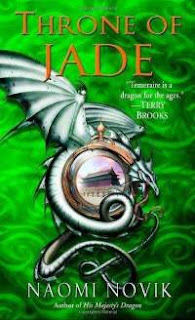
Book Review - Throne of Jade, by Naomi Novik
I was all riled up after finishing the first book in this series. Napoleonic wars, plus dragons? What’s not to love? In theory, this second volume of the Temeraire series should have piled on the awesome, adding nineteenth-century China to the mix. Granted, the book was… mildly awesome. I guess. In any event, it had all of the required elements to continue the story of the first book. However, the story and pacing is so weirdly listless that it was difficult to get excited at all about it.
The second book follows up on Temeraire’s origin as a mere egg: a gift from the emperor of China to Napoleon, seized en route by the Royal Navy. In the intervening time, the emperor has discovered the whereabouts of his truant gift, and furthermore, what use it has been put to. As revealed in the last book, Temeraire is a rare breed of dragon called a Celestial, bred as companions to royalty and expected to live as scholars rather than soldiers. Laurence, his loyalties already painfully divided, is summoned to the emperor’s court to answer for these twin affronts. As he and Temeraire begin the long journey to China, Laurence increasingly finds himself herded towards choosing between losing his beloved dragon and giving the hated French a powerful new ally.
The key phrase above is “long journey to China.” Most of the book is a drawn out ship voyage, which lends a certain staidness to the proceedings. Even with the occasional punctuation of action- some related to the larger plot, and some not- the middle of the book plods along, not really going beyond just marking time. It’s well-written, to be sure; the characters are still lovable, the dialogue has just the right amount of authentic stuffiness, and the blending of genres is as charming as it was in the first book. However, I found it difficult to stay engaged throughout the majority of the voyage.
When Laurence and Temeraire finally get to China, the damage kind of felt like it was done. Novik does some interesting things at this point, contrasting the way dragons are treated in Chinese society to the social norms that Laurence and Temeraire have heretofore taken for granted. The political intrigue is ratcheted up a bit, too, as the choice Laurence thought he was facing is revealed to be considerably more complicated. Again, though, nothing seems to rise above a dull roar. By the time the villains are revealed and the climactic confrontation begins, I was dismayed to realize that I didn’t really care enough to be affected too much by it. Especially considering that it plays out exactly as foreshadowed.
I don’t know. I liked this book, but I wanted to like it more, since I was so excited by the first one. This book technically works as a standalone, but I wouldn’t suggest starting with it. It’s weak compared to the first book, but it does reveal some interesting backstory on what Temeraire is and where he comes from.
Verdict: 2.5/5
The second book follows up on Temeraire’s origin as a mere egg: a gift from the emperor of China to Napoleon, seized en route by the Royal Navy. In the intervening time, the emperor has discovered the whereabouts of his truant gift, and furthermore, what use it has been put to. As revealed in the last book, Temeraire is a rare breed of dragon called a Celestial, bred as companions to royalty and expected to live as scholars rather than soldiers. Laurence, his loyalties already painfully divided, is summoned to the emperor’s court to answer for these twin affronts. As he and Temeraire begin the long journey to China, Laurence increasingly finds himself herded towards choosing between losing his beloved dragon and giving the hated French a powerful new ally.
The key phrase above is “long journey to China.” Most of the book is a drawn out ship voyage, which lends a certain staidness to the proceedings. Even with the occasional punctuation of action- some related to the larger plot, and some not- the middle of the book plods along, not really going beyond just marking time. It’s well-written, to be sure; the characters are still lovable, the dialogue has just the right amount of authentic stuffiness, and the blending of genres is as charming as it was in the first book. However, I found it difficult to stay engaged throughout the majority of the voyage.
When Laurence and Temeraire finally get to China, the damage kind of felt like it was done. Novik does some interesting things at this point, contrasting the way dragons are treated in Chinese society to the social norms that Laurence and Temeraire have heretofore taken for granted. The political intrigue is ratcheted up a bit, too, as the choice Laurence thought he was facing is revealed to be considerably more complicated. Again, though, nothing seems to rise above a dull roar. By the time the villains are revealed and the climactic confrontation begins, I was dismayed to realize that I didn’t really care enough to be affected too much by it. Especially considering that it plays out exactly as foreshadowed.
I don’t know. I liked this book, but I wanted to like it more, since I was so excited by the first one. This book technically works as a standalone, but I wouldn’t suggest starting with it. It’s weak compared to the first book, but it does reveal some interesting backstory on what Temeraire is and where he comes from.
Verdict: 2.5/5
Wednesday, September 14, 2011
Book Review - A Dance with Dragons, by George R. R. Martin
George R. R. Martin would like you to know that he bought a dictionary of archaic Scottish English in the six years it took to write this book, and he learned a lot of cool words from it.For example, did you know “leal” was used instead of loyal? It’s true! Also, you can use “neeps” to refer to rutabaga or turnips. And we already know that the word “teats” is awesome, of course, but let’s not forget the marvelous utility of the word “cunt!” It can refer to a woman’s body part, the woman herself, or just be a general exclamation of frustration in any situation where a woman might be involved to the slightest degree!
So, if you’re as excited about these words as you were to read about “groats,” “nuncles,” and “valonqars” in 2005, make sure to pick up A Dance with Dragons. George is so excited about this new batch of words that you are sure to get your money’s worth! Cunt leal cunny cunt leal teats neeps neeps cuntcuntcunt.
Okay, for real, now. I kept my hopes at a reasonably low level after the massive letdown that was A Feast for Crows, and it’s a good thing I did, because there is no appreciable difference between that book and this one. On one hand, that’s kind of a good thing; these two books started as one book, and inhabit the same chronological space in the overarching story while encompassing two different groups of main characters. A radical shift in the writing would have been jarring. However, setting aside the problem of this format slowing the overarching story down to a crawl, the consistency also means that the same infuriatingly bad writing in A Feast for Crows is slathered all over this one, as well, which distracted me from the truly gripping story underneath.
The War of Five Kings is all but over, but the stage is being set for the return of House Targaryen, which could change everything. Daenerys Targaryen struggles to maintain her hold on the slaver city of Meereen, while enemies descend on her from all sides and her famed dragons grow increasingly hard to control. A number of potential suitors race across the narrow sea to her, hoping to win her hand and tip the balance in Westeros: Victarion Greyjoy of the Iron Islands, Quentyn Martell of Dorne, and a young sellsword boy who hides a powerful secret. Even Ser Jorah Mormont hopes to once again reach the exiled queen, with none other than Tyrion Lannister in tow. Meanwhile, Jon Snow keeps his eyes fixed beyond the wall, balancing a tenuous grasp on the Night’s Watch command with the need to do anything it takes to defend against the horrors that are coming with the winter. And, let’s see… Bran’s up in the north learning how to be the best skinchanger ever, while Arya’s still in Braavos learning how to be awesome.
In other words, lots of Going Important Places and Saying Important Things, and not much else. There’s plenty of action interspersed in the various chapters and settings, but most of it is subdued; we’re back to intrigue and foreshadowing as we build up to what promises to be a huge denouement in the final books. The problem is, Martin has established himself to be a master at world-building and writing on a large scale, but as the last book proved, he’s god-awful at writing dialogue and creating small, intimate scenes. Unfortunately, dialogue and intimate scenes make up the lion’s share of this book. So, even though most of these chapters are still pretty interesting, they don’t move the story forward too much, and showcase some of the worst aspects of Martin’s writing.
As I mentioned above, Martin continues his maddening habit of suddenly introducing archaic words that don’t mesh at all with the rest of the prose, and repeating them until you want to use the book to bash your own face in. He also continues to invent new clichés that didn’t exist in the books before, and throw them around like confetti. In this book, people aren’t speculating on anything’s worth in groats anymore, but they all agree that “words are wind.” It’s not just the Westerosi who mutter this gem at any given opportunity; people across the sea, who supposedly speak entirely different languages, are also prone to blurting it out whenever anybody promises anything to anybody else. Also, it’s apparently in fashion to point out that nipples on a breastplate are useless. That one shows up at least twice, and then… spoiler alert!… somebody finds an actual breastplate… with nipples on it! Ha ha! Ha. Meanwhile, expect Tyrion to basically repeat two things for the entire book. Considering how great a character he has been to this point, this is particularly depressing.
The sex scenes, frequent as ever, continue to range between somewhat odd and painfully bad. Well, at least this time Martin isn’t obsessively fixating on the differing sizes and colors of women’s nipp… oh, wait, there it is. And… yup. There’s another passage, a few chapters later. Sigh.
I know I’m nitpicking, but there are bigger issues at play, too. Entire story threads in this book are completely unnecessary. One particular character winds their way through the book, doing nothing much of note, and then suddenly dies at the end after accomplishing one thing of pertinence to the story. This is something that could have been handled in a single chapter. It could have been an aside in someone else’s chapter, for crying out loud. While stuff like this is good flavor text, it takes up a lot of space without adding much.
I’m being harsh, but I really do like this series, and since Martin is king of the fantasy world right now, there’s no point in lobbing softballs. I think Martin has started to believe his own hype. These books have become famous for their grittiness, and for no character being safe and no happy ending being guaranteed. It seems like Martin just assumes, by this point, that he can please the fans that have those expectations by just writing in as much casual violence and pointless sex as he can, and ending every chapter on a cliffhanger. Moreover, the series is starting to suffer from the same affliction that can be observed in every successful popular fiction series: once an author starts raking in wheelbarrows of money, nobody wants to suggest that their manuscripts need editing anymore. According to Clarion West, this man teaches other writers how to write fantasy and science fiction. It’s therefore somewhat alarming to observe that he not only didn’t recognize that his two most recent thousand-page novels should have been three-fifths of a single manuscript (at best!), but that he feels the best way to establish a leitmotif is with unrelenting, context-free repetition. The fact that things go wonky when he strays from that repetition (“womb” is not a synonym for vagina, George) doesn’t do much to reassure me. And nobody seemed to have the courage to point these things out to him. Or, more likely, nobody cared, since this book was bound to be a bestseller anyway, regardless of whether it is actually good.
So, with me ranting full bore about this book, is it safe to assume I hated it? Sigh. No. I devoured it, just like the rest of the series. Once again, it must be said that underneath all of the stupid crap is a solid, engrossing, intricate story. It’s tightly plotted, despite the sudden meandering pace, and the themes are smart, realistic, and consistent, even if they are poorly presented. This series is visceral. Each page is alive with textures, smells, sounds, and a sense of unflinching reality. There are important messages in this story, about the nature of power, the arbitrary whims of fate, and the ambiguity of concepts like morality and justice. And though I’m sick to death of Martin’s cliffhangers, there are a couple of jaw-dropping moments in A Dance with Dragons that promise big things in the next books.
It bears repeating that this book is basically the second half of A Feast for Crows, six years or no six years, and thus deserves the same rating I gave that one. I’m not done with this series. I’m still a fan, and I need to know what happens next. I still think anybody who reads fantasy should read the first three books in this series, at least. But this book and the one before are badly written. It’s as simple as that. Not bad enough to ruin the series, but bad enough to pale in comparison to the previous books. I’d be lying, though, if I said I didn’t like it enough to tear through it and wait in anticipation for the next one.
The nice thing about all of this, as my wife and I often joke about, is that I get to be a fantasy hipster, now. While the newcomers rave about Game of Thrones and buy the reprinted paperbacks with the HBO logo on the cover, I get to smooth my moustache, crack open a Pabst Blue Ribbon, and declare that I was into Game of Thrones before it was big, and was already disappointed with it before you ever heard of it.
Verdict: 2.5 / 5, plus extra credit for being gripping despite its massive shortcomings.
Subscribe to:
Posts (Atom)